






Profile view of a bearded man wearing a dark green baseball cap and a dark gray T-shirt against a plain light background.

Why your mini split leaks water in a Maine winter

Step 1 of 3: Equipment

Why is my mini split leaking water in the winter?

A mini split dripping water onto the floor or wall in the middle of a Maine winter is unsettling, especially when it's running in heat mode and cold is the last thing you'd expect to cause a leak. You're not wrong to think something's off. The question is whether it's a clogged line, a frozen coil, or something installed wrong from the start.

Ice is building up on the indoor coil and melting faster than the drain can clear it

In heat mode, the indoor coil runs cold enough that moisture in the room air freezes onto it, especially on nights well below freezing. When the unit cycles or the defrost kicks in, that ice melts all at once and overflows the drain pan instead of draining outside. A clogged condensate line makes it worse, since even a little meltwater backs up fast. Sometimes the cause is simpler: a drain line that was never pitched right when the mini split went in, so water sits instead of running out. Either way, water at the unit in winter usually means the drain path or the coil needs a look, not the refrigerant.

  1. Cold coil pulls moisture out of the indoor air.

  2. Water collects in the drain pan below the coil.

  3. The condensate line should carry it outside.

  4. A clogged or frozen line backs water into the unit.

Frozen Line or Clogged Line

Frozen drain line

  • Water in the condensate line freezes solid when the line runs through an unheated space like a garage or crawl space.
  • Ice blocks the line completely, so condensate backs up into the drain pan and overflows into the unit.
  • The outdoor end of the line can ice over too, especially after a stretch of nights well below freezing.
  • A frozen line usually means the leak shows up or gets worse during the coldest part of the winter, not right after install.
  • Once the line thaws, the leaking can stop on its own, which makes the cause easy to miss until it freezes again.

Clogged drain line

  • Algae, dust and debris build up inside the condensate line over time and narrow the path water can drain through.
  • A partial clog lets some water through, so the leak may be slow or only happen when the unit runs for a long stretch.
  • Clogs tend to show up regardless of outdoor temperature, so leaking in July and leaking in January can have the same cause.
  • A disconnected or sagging section of line can trap water even without any buildup at all.
  • A technician can run a line or vacuum through the drain to clear it and check the slope of the line while they're there.
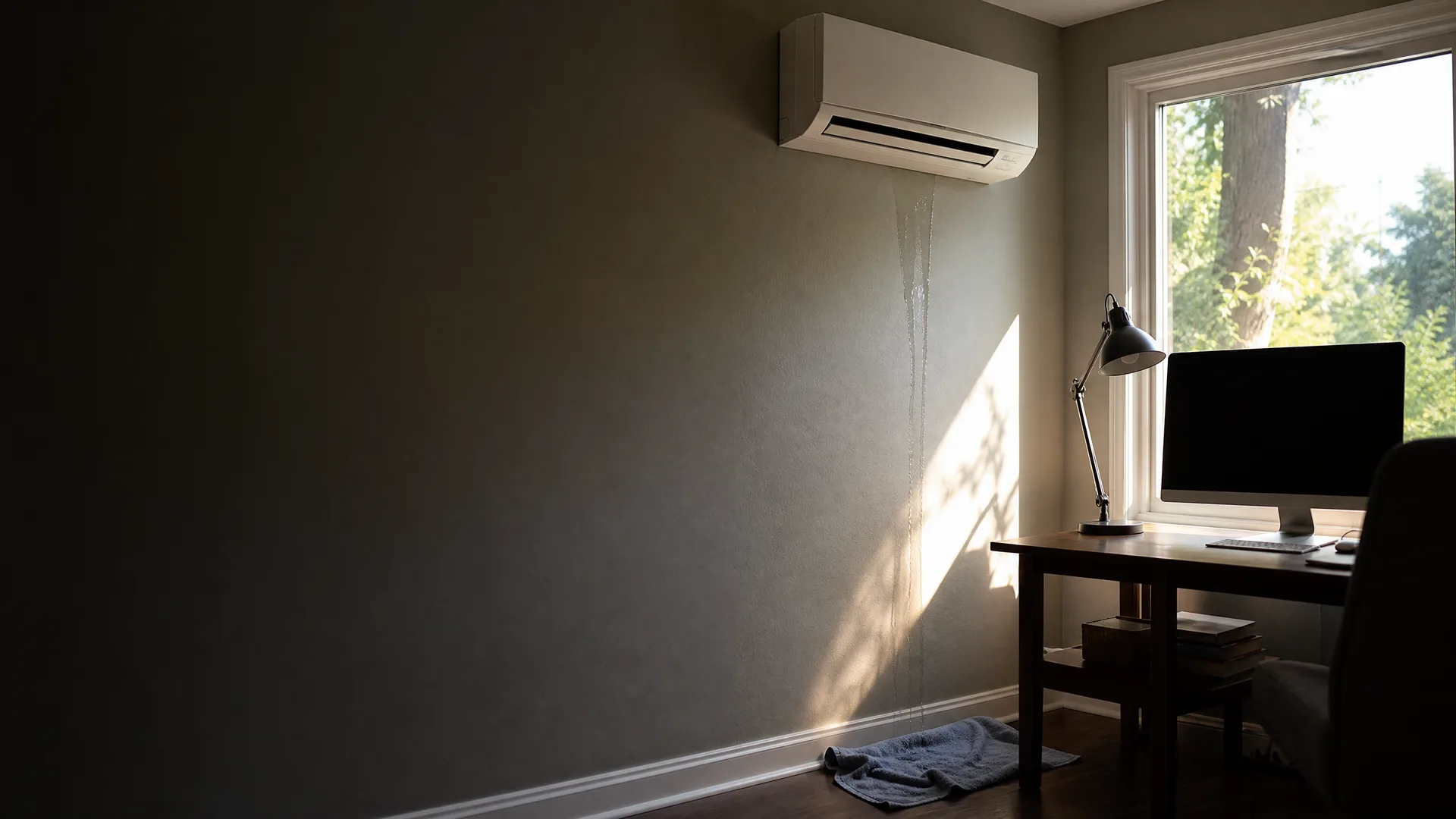
A wall-mounted mini-split air conditioner leaking water down a dim gray wall onto a towel on the floor, beside a window with a desk, lamp and monitor.

You're at the desk in the home office, working through the afternoon, when you notice the wall under the mini split has gone dark. A wet streak runs down from the unit toward the baseboard, and a small puddle has formed on the floor below it. You grab a towel and press it against the wall, then look up at the unit, which is running fine, no odd sounds, no error light. Outside it's the middle of a Maine winter, the kind of cold that doesn't let up for days. You check the towel again a few minutes later. It's already soaked through.

A white wall-mounted mini-split indoor unit high on a beige interior wall, with a potted olive-like tree at right and an armchair and window visible through a doorway at left.
A mini split that's clean and clear inside runs the condensate off the coil without a fight.
A wall-mounted mini-split air conditioner indoor unit with visible dust and staining, installed on a beige interior wall below white crown molding.
Months of dust packed around the vents give the drain line more to trap and more reason to back up.

Heat mode still makes condensate. The indoor coil pulls a little moisture from the air even when it's warming the room, and that water has to drain out through the same line as always. Where that line runs matters more in winter than people expect. If it passes through a crawl space or a wall cavity that doesn't get any heat, the line itself can sit well below freezing even with warm air blowing into the room a few feet away. Water sitting in a frozen section has nowhere to go. It backs up into the unit instead, and the ice doesn't clear on its own until outdoor temperatures climb and stay up for a while, which in Maine can mean a long wait. A technician checking this looks at the wall penetration first, where the line crosses from heated space to cold, since that's usually where the freeze starts. Thawing the ice gets water moving again for the moment, but unless whatever let that section get cold gets addressed, the next cold snap backs it up the same way.

Why the Line Freezes in Winter

  • The indoor coil sits in heat mode too, pulling a small amount of moisture out of the air even while the unit heats the room.
  • That condensate still has to run downhill through the drain line to get outside, no matter the season.
  • In a cold crawl space or an unheated wall cavity, the line itself can drop below freezing even though the room side stays warm.
  • Once ice forms inside the line, it doesn't melt on its own until the outdoor temperature climbs well above freezing for a stretch.
  • A technician can confirm a frozen line by checking for a clog with no visible blockage right at the wall penetration, where the line goes from warm to cold.
  • Thawing the line without fixing why it froze just means the same backup happens on the next cold snap.
A gray-haired man in a dark sweater sits on a light gray sofa in a living room, looking toward a sunlit window with trees outside.
A gray-haired man in a dark blue sweater sits on a light gray sofa in a sunlit living room, looking off to the side, with a potted plant, shelving unit, and large glass doors behind him.
A bearded man with graying hair in a dark green sweater sits on a sofa in a living room, looking off to the side, with a sliding glass door and a dim kitchen doorway behind him.
A gray-haired man in a dark knit sweater sits on a light gray sofa in a living room, looking toward a sunlit window, with houseplants, a lamp, and framed art in the background.

One form, no calling around

A frozen or clogged condensate line in a Maine mini split isn't a job you want to guess at twice, and finding someone who actually works on ductless systems in this state can take longer than the leak itself. A lot of HVAC outfits up here are built around oil furnaces, not the heat pump in your living room, so you end up calling two or three places, describing the same wet wall and the same puddle each time, before you find one that knows the line and the pan on your unit. That search is what you skip here. Your request goes to one licensed contractor local to you, someone who services mini splits through the winter and has seen this exact line freeze in this exact cold before. No explaining the problem over and over, no sorting through quotes from companies that don't touch ductless systems. You get back to the puddle on the floor and the wet streak on the wall, and someone who already knows what's usually behind it.

Heat mode still makes condensate

A mini split in heat mode is still pulling some moisture off the indoor coil, just less than it would in summer. That water still needs the drain line to carry it outside. People expect a leak like this in July, not January, which is why a January leak throws them off. The coil doesn't stop producing condensate just because the unit switched from cooling to heating. It's a smaller amount, but it still has to go somewhere, and the line is the only way out.


Why the line freezes here

Maine winters push hard freezes into any space that isn't heated, and that includes crawl spaces and parts of a garage where a condensate line might run. Water sitting in that line turns to ice, and ice doesn't move. Once the line is blocked, every bit of condensate behind it has nowhere to go but back into the pan and over the edge. A line that drained fine in October can freeze solid by January without anything else about the unit changing.

Power costs 27.69 cents per kilowatt-hour statewide

At 27.69 cents per kilowatt-hour, running a space heater or a dehumidifier to work around a leaking mini split adds up fast. Getting the condensate line cleared and the unit running right again costs less than patching around the problem all winter on Maine power rates.

EIA-861 2025 statewide residential average

Leave it alone and the water keeps finding the same path out, onto the wall or down into the floor, until something underneath it warps or stains for good.

Clear the line and get the drain pitched right, and the unit goes back to doing what it's supposed to do all winter: pull moisture off the coil and carry it outside without you ever seeing it.

A middle-aged woman with shoulder-length dark hair, wearing a gray cardigan over a cream top, sits in an upholstered armchair and looks toward a sunlit window, with a shelf holding framed pictures and a plant behind her.
A woman and a child wrapped together in a knitted gray blanket on a couch, with the child's head resting on her shoulder and a lit table lamp and houseplant in the background.
A two-story house with light beige horizontal siding, a gabled roof, a small covered front porch with dark door, and shrubs along the foundation, set behind a mown lawn and wet sidewalk with large leafy trees on both sides.

Summers in Maine run mild, but the air still carries moisture, averaging a dew point of 59°F across June, July and August according to NOAA climate data. That's enough for your mini split's indoor coil to pull a steady stream of condensate all summer, and the drain line handles it without trouble as long as it's clear and pitched right. The problem shows up later. Whatever builds up in that line over the summer, dust, a bit of algae, grit from the coil, is still sitting there when the weather turns cold and the line is more likely to freeze or back up in heat mode.

NASA POWER T2MDEW county cells weighted by homes

Is that water going to ruin my wall or floor?

You probably noticed it the same way most people do: a dark patch on the wall under the indoor unit, or a puddle on the floor that keeps coming back no matter how many times you wipe it up. Sometimes there's a musty smell starting in that corner of the room before you ever see water. If the unit sits over wood flooring or drywall, that water doesn't just sit there. Left alone, it soaks in, and wood floors cup or stain where it's been sitting, drywall softens and discolors, and trim at the baseboard can swell. None of that shows up overnight, but a leak that's been running for weeks does more damage than one you catch in the first day.

A white wall-mounted mini-split air conditioner unit installed high on a beige interior wall below white crown molding, with a window and woven shade at the left edge showing green foliage outside.

Running clean

This is what a mini split should look like: vents clear, case free of dust, condensate moving off the coil and out through the line without anything in its way. No streaks on the wall below it, no puddle forming on the floor.

A dusty, stained white wall-mounted mini-split air conditioner indoor unit installed high on a plain off-white interior wall near the ceiling.

Running dirty

Dust built up around the vents like this gives water somewhere to collect instead of draining off. A unit left like this for months is the one more likely to back up and leak, especially once a Maine winter has the line sitting in cold air.

A mini split leaking in winter almost always comes down to the condensate line, frozen, clogged, or pitched wrong, and that's a fixable thing once someone gets eyes on it. Not every HVAC company in Maine spends much time on ductless systems, since so many homes here still heat with oil, but the one matched to you does. A local contractor who services mini splits all year, through the muggy stretch in summer and the cold months when the drain line is most likely to freeze, has seen this exact leak before and knows whether it's the line, the pan, or the pitch. You deal with one contractor, not a handful of quotes to sort through and explain the same leak to again. Get the line cleared and the drain pitched right, and the unit goes back to pulling moisture off the coil and carrying it outside the way it's supposed to, no water on the wall, no puddle on the floor, through the rest of this winter and the next one.

A dark standing-seam metal roof with a stone chimney and metal cap, seen against a backdrop of autumn-colored forest and layered hills under an overcast sky.

Skip the search

Get one local pro

No fee to send it, and nothing to sign.

That leak won't fix itself by spring. Send one request and a local tech who actually services mini splits looks at the line, the pan, and the pitch, instead of you calling around to outfits that mostly do oil heat.